News

We want your input!

Flagstaff County Council invites residents to share their perspectives on County programs and services through an online survey. Your feedback will help identify what is working well, where focus is needed, and what emerging needs may shape the future of our region. Please note that the survey takes about 10 minutes to complete.

Take the survey HERE.

Survey deadline: March 1

Other ways to share your input

In addition to the survey, residents can also share their thoughts through the following opportunities:

Brainstorm Board

Have an idea or suggestion? Share it HERE.

View and support ideas from other residents HERE.

Brainstorm Board deadline: March 1

Coffee with your Councillor

Join members of Council for an informal, come-and-go open house on Tuesday, Feb. 17 from 5 to 7 p.m. at the County Office. Ask questions, share your thoughts, and connect directly with your Councillor over a cup of coffee.

You could win $500 in Flagstaff Bucks

Did we mention you can win $500 in Flagstaff Bucks?!

Yes, residents who take part in this year’s public engagement will be entered to win $500 in Flagstaff Bucks, redeemable at participating local businesses.

Complete the survey and include your email address to receive one entry. Submit an idea on the Brainstorm Board to receive another entry. Attend Coffee with your Councillor and you will receive an additional entry.

Email us

Residents may also share feedback or questions by emailing us at: publicinput@flagstaff.ab.ca.

Every perspective helps inform priorities and supports the path ahead for Flagstaff County.

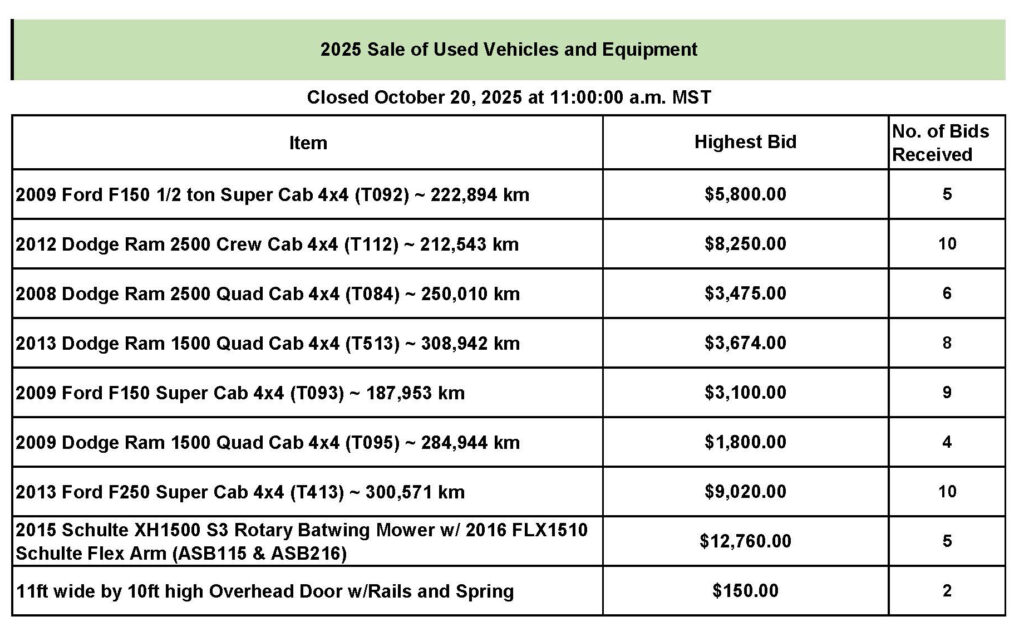
Results of used graders tender

The results are now available for the Tender for Sale of Used Graders, which closed on Friday, January 23, 2026 at 11 a.m.

Details are outlined below.

Coffee with your Councillor

Join us for Coffee with your Councillor, an informal and welcoming open house where Flagstaff County residents are invited to share their thoughts, ask questions, and connect directly with members of Council in a relaxed setting.


Tuesday, February 17, 2026
5 to 7 p.m.
Flagstaff County Administration Building


You’ll have the opportunity to visit with:

• Murray Hampshire, Reeve – Division 3
• Leslie Heck, Deputy Reeve – Division 5
• Amy Jackson, Division 1
• Alexis Ponto, Division 2
• Lori Lindseth, Division 4

This is your chance to “espresso” yourself on local priorities, ideas, and what matters most to you all while enjoying a cup of coffee and good conversation.

Bonus: All attendees will be entered into this year’s public engagement draw for $500 in Flagstaff Bucks.

We hope to see you there.

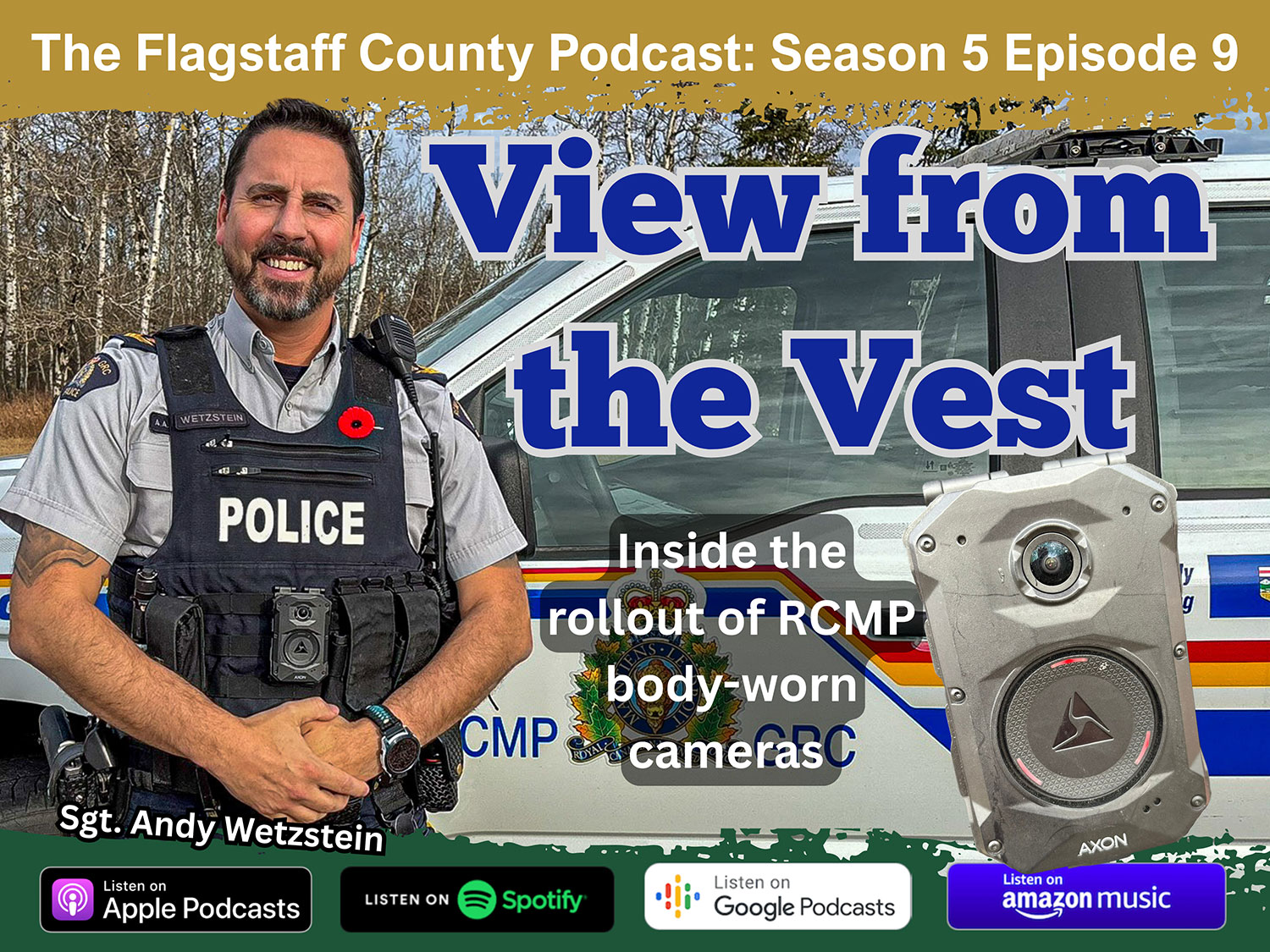
New Podcast: View from the Vest

Body-worn cameras are now part of everyday policing across the RCMP – but what does that actually look like in our community?

In this episode, host Cary Castagna sits down with Sgt. Andy Wetzstein, Commanding Officer of the Killam RCMP Detachment, to talk about the recent rollout of body-worn cameras in the Flagstaff Region. They discuss when the cameras are used, how footage is managed, and what the public can expect to see as this new technology takes shape in the field.

Listen on Spotify below.


Have your say!

The RCMP is seeking feedback from Canadians about their perceptions of police officers and their use of body-worn cameras.

Your input will help encourage conversation between the RCMP and the communities they serve, ensuring body-worn cameras are used in a way that respects diverse cultures and communities.

Click HERE to take the survey.

Battling the Boxelder (Maple Bug)

By Nick Dunn

Boxelder bugs, often called maple bugs, have become an unwelcome nuisance across Flagstaff County this fall. They are covering sunny walls, gathering around doors and windows, and entering into buildings. These small black-and-orange insects are not dangerous, but their numbers have reached levels not seen in several years. Many residents have asked why they are so bad this year, how long they will last, and what can be done to control them.

Maple bugs are native to North America and a familiar part of prairie life. They feed mainly on the seeds and leaves of boxelder and other maple trees. In most years, they remain in low, manageable numbers. The insects overwinter as adults, sheltering under tree bark, in organic matter, or inside buildings. In spring, they emerge to lay eggs on young leaves and developing seeds. During hot, dry summers, they can complete multiple generations, leading to the large late-summer and fall populations we are currently experiencing.

This year’s outbreak can be traced to favourable weather and growing conditions. The warm, dry summer allowed more eggs and nymphs to survive, while last winter’s mild temperatures helped adults overwinter successfully. At the same time, boxelder and maple trees produced a heavy seed crop, providing abundant food. With high survival rates, plentiful food, and hot weather, populations can increase rapidly.

As fall progresses, maple bugs instinctively search for warm, sheltered places to spend the winter. They often gather in greatest numbers on sunny south or west sides of buildings. From there, they look for any small opening to squeeze into wall cracks, attics, or basements. While they do not bite, chew wood, or damage structures, they can stain walls and fabrics and can make an even bigger mess when crushed. For this reason, residents should avoid crushing them indoors. Instead, use a vacuum or sweep them gently into a container for disposal.

The sheer number of bugs this year has made them a major nuisance across Flagstaff County and surrounding areas. Fortunately, the problem is temporary. Once the first hard frosts arrive, the insects become sluggish and die off in exposed areas. I have already started to see them become docile with the cooler nights. Only a portion of the population will successfully find overwintering shelter, and by late fall, outdoor activity drops sharply. During the winter, some may reappear indoors during warm spells, but they do not reproduce inside homes and will eventually die off without access to food.

Whether next year will be as bad depends on several factors. A cold, harsh winter would reduce survival, and a cooler, wetter summer in 2026 would limit population growth. However, if Alberta experiences another hot, dry year and boxelder trees again produce abundant seeds, another heavy infestation could occur next fall.

Residents can take several practical steps to reduce infestations. Prevention is the most effective control. Sealing cracks and gaps around windows, doors, vents, and siding will keep bugs from entering buildings. Replacing damaged window screens, installing door sweeps, and caulking around utility openings all help. Outdoors, using a strong jet of water or a light soap-and-water spray can dislodge clusters from walls without harsh chemicals. Spray Nine is also effective for cleaning and removing maple bugs and stains. It rinses off more easily than soap solutions and removes the dark fluid they release which is a defensive mechanism and fecal matter. Keeping yards free of leaves and organic debris will also help reduce next year’s populations be removing areas for them to overwinter.

Chemical insecticides can be used as a last resort but should always be applied according to label directions. Spraying foundations and lower walls in late summer before bugs begin to cluster can provide short-term relief, but benefits are temporary and overuse can harm beneficial insects, pets, and yourself. Indoors, vacuuming remains safer and more effective than spraying. Maple bugs are primarily a nuisance rather than a threat. With some preparation and patience, their numbers will decline as the weather cools. Residents who take time now to seal entry points, clean up potential habitats, and avoid crushing the bugs will be better prepared to prevent future infestations.

Nick Dunn is Flagstaff County’s Agricultural Fieldman. He can be reached via email at: ndunn@flagstaff.ab.ca or by phone at: 780-384-4138.


Use Crop Desiccants As Directed

By Nick Dunn

Pre-harvest tools like desiccants and harvest aids can be valuable for speeding up dry-down and reducing weather risk. But timing, method, and market acceptance are critical; the wrong choice can cost you grade and marketability.

Most desiccants are contact products meaning they only dry down the green plant tissue they touch. If sprayed too early, you lock in green, lightweight, or shriveled kernels. Too late, and there’s little benefit. In cereals, the right stage is the hard dough phase, when kernels resist a thumbnail and moisture is about 30% or less. For peas, 75–80% of pods should be brown, with lower pods rattling. In flax, the crop should be about three-quarters brown, while in canola, 60–75% of seeds on the main stem should show color change from green to brown, black, or yellow. Following these benchmarks protects seed quality while still giving the crop a dry-down boost.

Glyphosate is often discussed at harvest, but it’s not a true desiccant. The systemic herbicide moves inside the plant and can carry into the seed if applied before 30% seed moisture, reducing germination and raising residue concerns. Many buyers, especially for malt barley, peas, and some wheat classes, reject glyphosate-treated crops. True desiccants such as diquat, saflufenacil, glufosinate, flumioxazin, and carfentrazone act on contact only and do not move into the seed. Buyer standards do vary, and some markets won’t accept crops treated with desiccants at all. Know before you spray!

Residue concerns go beyond local rules. Export markets follow maximum residue limits (MRLs), which may differ from Canadian standards. Even if a product is registered, exceeding another country’s limits can result in rejection at port. Spraying at the correct crop stage, using only registered products, and checking with buyers beforehand reduces this risk and helps protect your market access.

Good coverage is one of the biggest factors in successful desiccation. Because these products only work where they touch, high water volumes of at least 20 gallons per acre are recommended. Skimping on water often leaves green patches that slow down harvest. Weather also plays a role. Some desiccants work best under bright sunlight when plants are actively photosynthesizing. Cool or cloudy conditions reduce effectiveness, so choosing the right day can make a real difference.

How the product is applied also matters. High clearance ground sprayers usually deliver the best coverage, but aerial spraying by plane can be useful when fields are large or too wet for ground equipment. The downside is increased drift risk and less ability to hit recommended water volumes. Mechanical methods like swathing remain valuable in certain crops, particularly canola, where cutting and windrowing at the right time can even out maturity and reduce shattering losses.

This year in Flagstaff County, crops emerged fairly evenly. That reduces the pressure to rely on desiccants and gives growers the option to let crops dry naturally. Even so, unpredictable fall weather may still push some toward chemical or mechanical aids to protect yield and avoid delays.

Nick Dunn is Flagstaff County’s Agricultural Fieldman. He can be reached via email at: ndunn@flagstaff.ab.ca or by phone at: 780-384-4138.

Environmental Farm Planning – Ticket for Ag Funding

By Nick Dunn

Are you looking to improve environmental practices on your farm and unlock cost-shared funding for key upgrades and improvements? Now is the time to complete or update your Environmental Farm Plan (EFP). An EFP is a free, voluntary, and confidential tool that helps producers assess environmental risks within their operations and identify improvements. It’s a practical way to protect your land and water — and it’s also your ticket to funding through the Sustainable Canadian Agricultural Partnership (SCAP) and other grant programs.

Launched in Alberta in 2003, the EFP program originally used paper binders, but as of 2019, it’s fully online. A major update released in 2023 introduced a 10-year renewal process that is a more flexible and user-friendly experience for producers. To date, over 25% of producers in Western Canada have completed their EFP — and the benefits go beyond the environment.

Having a valid, up-to-date EFP is required to access many government cost-share programs—especially under SCAP, which launched in April 2023. Programs under SCAP include the Farm Technology Program, Water Program, Resilient Agricultural Landscape Program (RALP), and the Efficient Grain Handling Program. These support a wide range of on-farm improvements such as water management systems, riparian protection, shelterbelts, soil health practices, precision ag tools, and energy-efficient grain drying equipment. Additional programs under SCAP also fund innovation, value-added processing, public trust initiatives, and ag education. Having an EFP in place ensures you’re eligible when these funding opportunities open — many of which are first-come, first-served. In addition, there are federal business risk management (BRM) programs such as AgriStability, AgriInvest, and AgriRecovery, which offer financial protection against severe income losses, margin declines, and natural disasters.

If you are interested in completing your EFP, you can register for an account at https://albertaefp.com; and login to get started on creating your workbook. After registering you will be assigned to a technician from your region. Flagstaff County does have EFP Technicians available for assistance that you can work with to complete your plan. Some producers complete the plan without assistance; however, it is recommended to complete the first two chapters with a technician to learn how to navigate the site and get it properly set up. Chapters 1 and 2 contain the most information to report on and getting started with a technician may save producers from completing unnecessary work.

Within the EFP website, there will be a list of upcoming workshops and events that are free for producers to attend. Producers have the option to complete their EFP virtually through workshops, or through local workshops hosted by organizational groups including Flagstaff County. The next available workshops are virtual and will be hosted on July 4, 9:30 a.m. – 11:30 a.m., and on July 23, 1:30 p.m. – 3:30 p.m. Producers can go online to the EFP website to register for free. Flagstaff County will be hosting an in-person workshop at the County Administration Building on July 2, from 8:30 a.m. to noon. Limited spots are available, so be sure to register at 780-384-4100.

The time it takes to complete an Environmental Farm Plan (EFP) can vary depending on the type and complexity of your farming operation. Every farm is unique, and the EFP is designed to reflect that. Operations with higher levels of environmental risk — such as those near water sources, with intensive livestock production, or using certain inputs — may take a bit more time to assess and plan for. On the other hand, farms with lower risk may be able to complete the process more quickly. The goal is to identify areas where environmental improvements can be made and to create a practical, achievable plan that fits your needs. Ultimately, the time investment up front helps ensure a more sustainable and profitable farm in the long run, and it is only as good as the care and honesty you put into assessing your operation.

Nick Dunn is Flagstaff County’s Agricultural Fieldman. He can be reached via email at: ndunn@flagstaff.ab.ca or by phone at: 780-384-4138.

Tell Officer Skyler about Positive Deeds!

Nominating a child in Flagstaff for a positive ticket just got easier.

Now you can do it online HERE.

Positive tickets are issued for positive behaviour such as practicing personal safety, being a community hero and making smart choices. Our peace officer wants to be notified by teachers, coaches, friends and neighbours throughout the Flagstaff Region who have witnessed a child doing a positive or helpful deed, or performing a safe act that would be worthy of receiving a positive ticket.

You can also contact Officer Skyler Zelinski if you know of a deserving youth! Officer Skyler can be reached by phone at 780-384-4100 or via email at szelinski@flagstaff.ab.ca.

Positive tickets come with a $10 coupon that can be redeemed at participating businesses, as well as a bracelet for a free swim at the Killam Regional Aquatic Centre.

Let’s acknowledge the good that our young people are doing right here in Flagstaff!

Flagstaff Campgrounds Go Online for 2025 Season with Campspot

By Nick Dunn

Flagstaff County is excited to announce a major upgrade to our campground booking process for the 2025 camping season! In response to the Council’s direction to enhance our top three campgrounds—Diplomat Trout Pond, Edgerton Day Campground, and Fish Lake Campground—we have transitioned to an online booking platform. 

Thanks to our partnership with Campspot, visitors can now conveniently reserve campsites online, pay with a credit card, view campground maps, and familiarize themselves with each campground’s amenities and rules before arriving. This move marks a significant shift away from our historical cash or cheque only, self-registration system, offering a more secure, efficient, and user-friendly experience for both campers and County administration.  

This software comes at no cost to the County. Campspot maintains its services through a $5 booking fee per reservation, which is paid by the visitor. This fee is proportionately distributed over the length of your stay. For example, a two-night stay at a serviced site would work out to $32.50 per night ($30 site fee + $2.50 per night from the booking fee). Our nightly rates remain the same: $25/night for non-serviced sites and $30/night for serviced sites. 

Campers can explore all available sites and make reservations easily through our website at: www.flagstaff.ca/campgrounds. Whether you’re planning a weekend fishing trip, a family getaway, or a relaxing escape into nature, our website provides all the tools you need to plan your perfect visit. New signs have also been installed that have QR codes visitors can scan to bring them directly to the booking website.  

Previously, our campgrounds operated on a self-registration basis using cash or cheque payments deposited in on-site boxes. Unfortunately, this system led to increased incidents of theft and vandalism. Transitioning to a cashless, digital system not only enhances security but also reduces staff time managing and retrieving cash. 

This initiative aligns with Flagstaff County’s broader push toward modernized, cashless services. Much like the current pilot project offering free water for agricultural and firefighting purposes at our tank loaders, this change helps us assess the benefits of moving to fully cashless operations across other County services in the future. In addition to our top three upgraded campgrounds, the Galahad Campground is also now available on the Campspot platform. Galahad offers seven full-service sites, perfect for RV and trailer camping, along with a unique group site located at the Municipal Grounds and Gazebo—available for $75 per night, plus the standard $5 booking fee. It’s an excellent location for family reunions, special events, or group getaways. 

So whether you’re a long-time local or a first-time visitor, we invite you to explore everything our beautiful campgrounds have to offer—now just a few clicks away. 

Nick Dunn is Flagstaff County’s Agricultural Fieldman. He can be reached via email at: ndunn@flagstaff.ab.ca or by phone at: 780-384-4138.